

Why your SEO is fine but AI search still can’t find you
You might have noticed that something has changed at the top of Google search results — certainly some of your potential customers already have.
Search for almost any local service today and you’ll likely see it. Before the familiar list of blue links, before the map pack, before any of the results you’ve spent time and money optimizing for, there’s an AI-generated summary. Google reads the web on your behalf and tells you: here are the businesses that answer your question.
That summary is called the AI Overview. It names two or three businesses. Sometimes fewer. And if your business isn’t one of them, the searcher may never scroll further to find you. This is happening right now, in your market, on the phones and laptops of people looking for exactly what you offer.
Learning about Generative Engine Optimization (GEO), the discipline of optimizing for AI inclusion, could be the most important thing you do for your online visibility this year. What is GEO? Read on…
The scale of what’s changed
Google AI Overviews now appear in roughly 16% of all searches — and that number has doubled in just a few months. In some categories, particularly health and professional services, they appear far more often than that.
Think about what that means in practice. A potential client in Havelock searches “New Bern accountant for small business.” An AI Overview appears at the top of the page. It names two firms. They call one of them. Your website, which may rank perfectly well in the results below, never gets seen.
In addition, a growing number of people are bypassing Google entirely and asking AI assistants: “who is a good family dentist in New Bern?” or “what’s the best marketing agency near me?” Tools like ChatGPT, Perplexity, Microsoft Copilot, and Google Gemini generate answers from the same raw material — your website, your Google Business Profile, your directory listings, your online reviews.
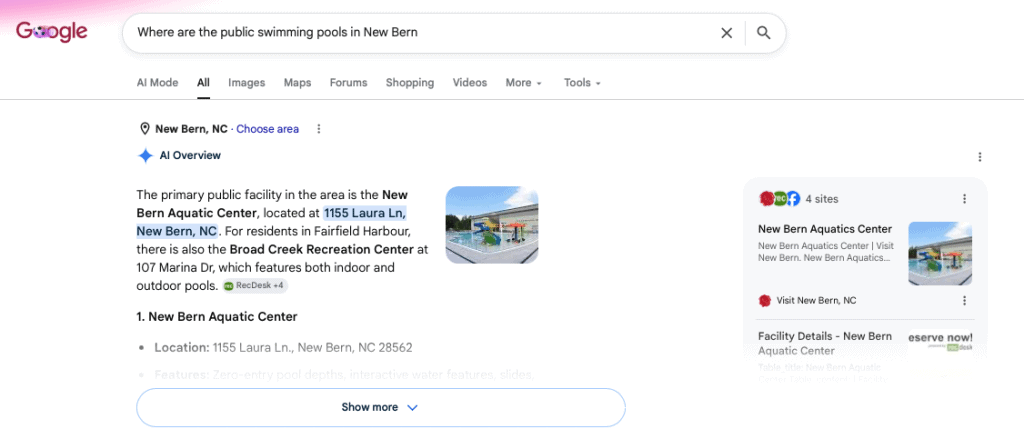
Fortunately there’s something you can do about it.
The discipline of optimizing for all of these AI-generated results is where GEO comes in. And it’s the next thing every local business needs to understand. So — what is GEO?
What is GEO? What it can and can’t do for you
Let’s be clear about one thing before we go any further.
Appearing in Google AI Overviews for competitive local queries is not something any agency can guarantee in the short term — including us. Any agency that promises you’ll be in AI Overviews next month is overstating what’s currently possible.
What IS achievable in the near term, and where the real opportunity sits right now for New Bern businesses, is visibility across AI search tools like ChatGPT, Perplexity, Microsoft Copilot, and Google Gemini. These tools update more frequently than Google’s core algorithm, weigh on-site signals more directly, and are more responsive to the specific GEO improvements we’re going to talk about. Businesses that get their foundation right can realistically expect to start appearing in those AI answers within 30 to 90 days.
More importantly, the foundation you build for visibility across AI search tools is exactly the same foundation that positions you for Google AI Overviews over time. You’re building once, for all of it — and the businesses that build that foundation now will have a compounding advantage over the ones that wait another year to start.
That’s the honest case for taking action now. Not because “you’ll be in Google’s AI results next month”, but because the businesses that are showing up in AI search down the road are the ones building this foundation today.
As an aside, you may also see this called:
- AEO (Answer Engine Optimization).
- LLMO (Large Language Model Optimization).
The terminology isn’t fully settled yet. Different platforms and practitioners use different terms, but they’re all describing the same shift and asking the same question: what is GEO and how can you use it to optimize your online presence for AI-generated answers.
We’re using the term GEO here because it’s currently the one that’s most widely recognized.
Ready to take action?
Want the complete step-by-step guide and compliance checklist?
The GEO-AI Search Do-It-Yourself Guide covers everything in this post in full detail — plain English, any website platform.
Get it here for $24.
What’s the relationship between SEO and GEO?
While SEO gets you ranked in the list of links, GEO makes it more likely that you’ll get named in the AI Overview above it.
These systems don’t compete with each other. In fact, a well-built site with strong SEO is already most of the way to GEO compliance. But GEO has specific requirements that SEO doesn’t, and most small business websites haven’t addressed them yet.
The five things AI tools look for
When an AI tool generates an answer about local businesses, it’s making a series of assessments. Here’s what it’s actually looking for:

Can it read your site? Some websites — including some that were properly set up for SEO — have settings that block AI crawlers. The robots.txt file in your website directory that tells web crawlers what they can and can’t access sometimes blocks tools like GPTBot (OpenAI’s crawler) or Google-Extended (which feeds Google’s AI products). If your site is blocking these, you’re invisible in AI search no matter how good your SEO is.
Does your site tell AI what you are? Schema markup is structured data that labels your content explicitly — your business name, address, hours, services, and the connections between all your online presences. Without it, AI tools have to guess. With it, they can accurately describe your business in a response.
Is your information consistent everywhere? AI tools cross-reference. If your phone number is different on your website than on your GBP, or your address is formatted differently on Yelp than on Bing Places, AI loses confidence in the data. It may not cite you as a result.
Does your content give direct answers? “We offer a comprehensive range of professional services to clients throughout the region” gives an AI nothing to work with. “We’re a New Bern-based accounting firm serving small businesses across Craven, Pamlico, and Carteret counties” gives it exactly what it needs to name you in a relevant response.
Are you mentioned anywhere beyond your own site? AI tools treat external mentions as validation and a kind of citation/certification. A business that appears on its own website, its GBP, a Chamber of Commerce directory, and a couple of local media mentions has multiple confirmation points. That confidence translates directly into more likely citation.
What this means for New Bern businesses specifically
If you serve a local or regional market — and most of our Spine & Leaf Media clients do — AI search has a very specific implication for you right now.
AI tools have become the new local directory. When someone asks “who’s the best chiropractor in New Bern” or “where should I get my car serviced near Havelock,” they’re increasingly getting an AI-generated answer that draws from GBP, review platforms, local directories, and your website.
The businesses showing up in those answers aren’t necessarily the biggest or the best-known. They’re the ones whose online presence is structured in a way that AI can read, trust, and confidently repeat.
Here’s what surprised me most when I started digging into the data: many of the businesses appearing in AI local search results aren’t doing anything exotic. But they have:
- A complete and active GBP.
- A name, address, and phone number that are identical across every platform on which they appear.
- Their website has a clear, specific description of what they do and who they serve.
That’s it. That’s the baseline.
Many businesses in this market haven’t done those things consistently, which means there’s a real window right now to establish visibility before the competition figures out what’s happening.
The good news if you’ve invested in your website
Let’s face it — if you’ve already built a solid website and done the SEO work, you’re not starting from scratch.
A well-built site with clear content, proper structure, and a maintained GBP already has most of what GEO needs. The gap between a good SEO foundation and GEO compliance is specific and addressable — it’s not a rebuild, it’s just a new layer.
If you’ve done the foundational work, the next-in-line GEO-specific steps are clear:
- Review who can crawl your site.
- Add schema markup.
- Complete your GBP fully.
- Make your content more specific and direct.
- Build external citations.
- Then monitor whether you’re showing up when potential customers ask AI about your services.
“The businesses furthest behind are those with poorly built sites, no Google Business Profile, and no consistent presence across platforms. If that’s you, GEO is not the place to start — but it’s absolutely where you need to end up.”
Where to start
The single fastest thing you can do today: ask your favorite AI tool “who is a good [your service] in New Bern, North Carolina?” See what comes back.
That’s your most immediate and measurable baseline. If you’re not in the answer, that’s what you’re working to change. If you are, check the accuracy of your business details.
At Spine & Leaf Media, we built the Online Performance Health Check to help you establish your current baseline and make recommendations to help you move forward.
It’s a $99 audit that assesses your online presence, including your website, social media, and any other mention of your business on the internet,
It measures your technical health, your SEO foundation, your GEO readiness, and delivers a clear report with prioritized recommendations to you within four business days.
It tells you specifically what’s working, what isn’t, and what should be fixed first.

But if you’re eager to start moving immediately, here’s the priority order that applies to most local businesses:
This week:
- Complete and activate your GBP fully, including hours, services, description, and photos.
- Start actively asking satisfied clients for Google reviews. Five or more reviews is the threshold that matters.
- Confirm that your business name, address, and phone number are identical across every platform on which you appear.
This month:
- Get listed with your local Chamber of Commerce and the BBB if you aren’t already.
- Add LocalBusiness schema markup to your website — Rank Math handles this if you’re on WordPress.
- Make sure your website has a clear, specific description of what you do, where you do it, and who you serve.
That’s the fast track: six moves, most of them free, that will put you in a position to start appearing across AI search tools within 30 to 90 days, and begin building the foundation for Google AI Overview visibility over time.
The bottom line
Search is changing: not overnight and not completely. But it’s changing in ways that are already affecting how potential customers in this market can find you.
The businesses that adapt early will have an advantage that compounds over time. The ones that wait will find they have to explain to themselves why they’re not showing up in AI answers while their competitors are.
GEO isn’t a replacement for SEO. It’s the next layer. And for small businesses in New Bern and across Eastern North Carolina, the window to establish that layer before it becomes table stakes is still open.
But not for much longer.
Ready to take action?
The GEO-AI Search Do-It-Yourself Guide walks you through every step in this post in full detail in plain English, no jargon, no assumptions about your technical background.
You get the complete implementation guide plus a step-by-step pilot’s checklist you can work through yourself or hand to your web professional.
$24.00
Spine & Leaf Media helps small businesses stand out through crisp writing, compelling photography and video, strategic SEO for stronger search visibility, and effective web design. If you need content or creative support that helps people find and trust your business, contact me and let’s start a conversation.